We use cookies to enhance your browsing experience, serve personalized content, and analyze our traffic. By clicking "Accept All" you accept this and consent that we share this information with third parties and that your data may be processed in the USA. For more information, please read our .
You can adjust your preferences at any time. If you deny, we will use only the essential cookies and unfortunately, you will not receive any personalized content.

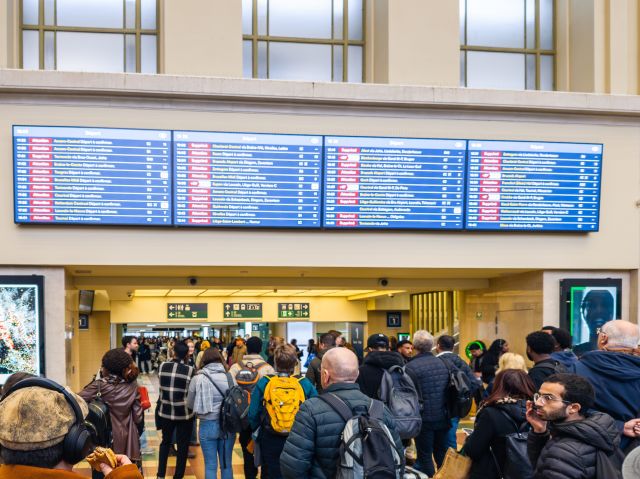
Belgium is having another difficult day for public transportation, and if you're catching a train to Brussels, Bruges, or Ghent, your usual timetable may be more of a suggestion than a reliable plan. A nationwide public-sector strike on Monday, October 12, 2026, is disrupting trains, buses, trams, and metros, with some regional rail services operating at half their usual frequency. Most InterCity trains are expected to run, and Brussels Airport says flights shouldn't be affected. Getting to the airport, however, could be another story. Here's what travelers need to know before heading out.
The rail strike runs through Monday’s last train, after disruption began Sunday, October 11, at 10 p.m.
About 70% of InterCity trains are expected to run, including services connecting Brussels, Antwerp, Ghent, Bruges and Liège.
Half of local and suburban trains will operate, along with just 20% of extra peak-hour services.
Most Eurostar, ICE, TGV INOUI and OUIGO trains are running, but some trains between Belgium and the Netherlands are cancelled.
Brussels Airport expects no impact on flights, though reduced trains and buses make the trip to the terminal harder.
Brussels South Charleroi Airport is keeping all flights, but warns its shuttle from Charleroi-Central may be heavily disrupted.
STIB-MIVB expects disruption on Brussels metro, tram and bus lines, with real-time updates from 6 a.m.
Belgium’s latest transportation disruption comes just three days after a national demonstration on Friday, October 9, when ground handlers at Alyzia joined the action and Brussels Airport lost about 140 flights. This time, the socialist public-sector union CGSP/ACOD is protesting federal budget proposals, and railway employees are among those taking part.
According to SNCB’s official announcement, the strike began Sunday evening at 10 p.m. and continues through Monday’s final scheduled trains. SNCB and infrastructure operator Infrabel built an alternative timetable around how many employees are available to work.
Belgium hasn’t come to a complete standstill, but its normally convenient transportation network has taken a hit. A cancelled commuter train is a manageable inconvenience for someone heading across town, but it gets considerably more complicated when that same train is supposed to connect you with an international departure. With disruption affecting several operators at once, checking your entire journey matters just as much as confirming the first train.
Belgium’s national railway has introduced a reduced timetable, but the disruption isn’t spread evenly across the network. Travelers moving between major cities generally have more options than those relying on smaller regional routes or extra peak-hour services.
According to SNCB’s published strike schedule, the alternative timetable includes:
InterCity trains keep the most service at 70%, so city-to-city sightseeing is still very doable. Shorter local hops will take a bit more patience.
InterCity services link Brussels, Antwerp, Ghent, Bruges and Liège, so many popular tourist journeys are still possible. Those national percentages don’t guarantee any particular departure, though. A route that normally has frequent trains might have fewer options today, while another could have a much longer gap between services.
Local and suburban travelers face the most disruption, especially during the morning and evening commute. SNCB has built the alternative timetable into its online journey planner and app, so you can see which trains are actually running before you leave for the station. If a train isn’t listed, it isn’t coming, and it’s worth leaving extra time since the trains that do run are likely to be busier than usual.
The picture is brighter for international travelers, although not every cross-border service is running normally. Most Eurostar trains are expected to run, and ICE, TGV INOUI and OUIGO services to and from Belgium are scheduled to operate normally.
Travelers heading to the Netherlands face bigger changes. The regular Brussels to Rotterdam EuroCity is running 12 of its usual 16 trains in each direction, and these departures from Brussels-Midi are cancelled:
9:44 a.m., train 9227
1:44 p.m., train 9243
4:44 p.m., train 9255
8:44 p.m., train 9271
Four trains in the opposite direction are cancelled too. Eurocity Direct services between Brussels and Amsterdam are running at roughly half their usual frequency, with eight of 16 trains toward the Netherlands and nine of 16 toward Belgium.
SNCB International has published ticket flexibility and refund arrangements for affected passengers, so check the official disruption page before buying a replacement ticket. And if you’re connecting from a domestic train, check that leg separately, because an international train running on time doesn’t help much if you can’t reach Brussels-Midi.
The national rail network isn’t the only system affected. In Brussels, STIB-MIVB has warned that passengers should expect disruption throughout Monday on metro, tram and bus services, depending on how many staff join the strike.
Unlike SNCB, STIB-MIVB hasn’t announced a percentage of services expected to run. The routes and frequencies depend on staffing, with real-time information published from 6 a.m., and the operator recommends making other arrangements where you can. That’s worth checking before you head out, especially for trips between hotels, railway stations and attractions that aren’t within walking distance.
Fortunately, central Brussels is compact enough that many of its best sights can be explored on foot. If you’re staying near Grand-Place or Brussels-Central, walking may well be easier than navigating a reduced metro and tram network:
Grand-Place: Brussels’ famous central square, ringed by ornate guildhalls and the Gothic Town Hall.
Royal Galleries of Saint Hubert: An elegant covered arcade full of chocolate shops, cafés and boutiques.
Manneken Pis: The city’s famously small and slightly ridiculous landmark, a short walk from Grand-Place.
Mont des Arts: Landscaped gardens with views over the historic center and several museums close by.
Places farther out, like the Atomium, will take more planning. A simple metro ride on an ordinary day can turn into a much longer trip when services are reduced, so check whether an attraction is realistically within reach before you leave your hotel.
Disruption also extends beyond the capital. De Lijn runs buses and trams across Flanders, including around Antwerp, Ghent and Bruges, while TEC serves Wallonia, where disruption has been reported on 58 bus routes in Walloon Brabant alone. Arriving in the right city by train is only half the journey if the bus to your hotel isn’t running, so confirm that final connection before you set off, particularly if you’re arriving late in the evening.
Brussels public transportation operator STIB-MIVB is warning passengers of disruption across its metro, tram and bus networks during the October 12 strike.
The good news for anyone flying is that Brussels Airport has said it expects no impact on air traffic from today’s strike, unlike Friday, when ground handlers walked out. The harder part is getting there. Brussels Airport (BRU) normally has easy rail connections to the city and the rest of Belgium, and those trains are part of the network running a reduced timetable today.
STIB-MIVB bus 12 also connects the airport with the city, and it has kept running on several recent strike days, but check that your departure is operating before you rely on it. A taxi or ride-hail car covers the roughly 7.5 miles from central Brussels, though demand and prices could be higher than usual.
If you’re heading to the airport today, these precautions are worth taking:
Check your flight first: Confirm its status with your airline or on the Brussels Airport website.
Verify the train connection: Use the SNCB journey planner to check services to Brussels Airport-Zaventem.
Check bus 12: See STIB-MIVB for live updates before counting on the airport bus.
Have a plan B: A taxi or transfer may be worth it if public transport isn’t cooperating.
Leave extra time: Allow a bigger margin than usual, especially for international departures or journeys with several connections.
Families with luggage or visitors new to Belgium’s transport system will find a bit of advance planning especially helpful. A cancelled airport train is inconvenient at the best of times, and considerably less entertaining when you’re trying to make an international flight.
Brussels South Charleroi Airport (CRL) has good news too. The airport has confirmed that all scheduled arrivals and departures will be maintained on October 12, although road access and public transport may be disrupted. It specifically warns that the TEC shuttle between Charleroi-Central station and the terminal could see significant disruption, so check your shuttle and allow extra time.
It’s also worth double-checking the airport code on your booking. BRU and CRL are separate airports about an hour apart, and discovering you’ve planned transport to the wrong one is especially unfortunate on a day when the trains aren’t cooperating.
Passengers flying through Brussels Airport should confirm both their flight status and ground transportation during Belgium’s October 12 strike.
The most useful advice for today is also the simplest, which is not to head to a station without checking your exact departure first. SNCB has already published its alternative timetable, and local transit operators are updating their services throughout the day.
If your plans are flexible, postponing a day trip and spending more time in the city you’re already in may be the easiest choice. If you have a flight, an international train or an important appointment, confirm those connections first and line up alternatives early. If your train is cancelled:
Look for another departure. SNCB’s journey planner includes the revised schedule and may suggest a different route.
Review your ticket options. SNCB publishes strike-related refund and exchange guidance on its strike page.
Keep your paperwork. Save your original ticket, cancellation notices, receipts and any extra expenses.
Ask for a disruption certificate. SNCB provides documentation that can help with travel insurance or other claims.
Contact onward providers. If a cancelled train affects a flight, international connection or hotel booking, let them know promptly.
Not every strike-related delay qualifies for compensation. Refunds and passenger rights depend on your ticket and the circumstances, so the operator’s published conditions are a better guide than assuming every extra expense will be reimbursed. The strike timetable runs only through Monday’s final trains, and SNCB hasn’t announced any extension into Tuesday, October 13, though it’s still worth checking for lingering delays first thing in the morning.
Brussels’ Grand-Place and nearby attractions can be explored on foot, giving visitors alternatives to disrupted public transportation during Belgium’s October 12 strike.
Belgium hasn’t stopped moving today, but this isn’t a day for tight connections or for trusting the usual timetable. Most InterCity trains are running, international trains are largely on schedule and flights are expected to leave as planned. If the strike hands you an unexpected afternoon in Brussels, Bruges or Ghent, all three have historic centers that reward wandering, and there are certainly worse places to be stranded. Preferably somewhere with waffles.
Yes. A public-sector strike is affecting Belgian rail services on Monday, October 12, 2026. SNCB is running an alternative timetable with about 70% of InterCity trains, 50% of local and suburban services and 20% of peak-hour trains.
Some InterCity trains are running between major Belgian cities, including Brussels and Bruges. National percentages don’t guarantee a specific departure, so check the SNCB journey planner before you travel.
Yes. Brussels Airport has said it expects no impact on flights from today’s strike. Trains and buses to the airport are reduced, so confirm your connection and leave extra time.
Charleroi has confirmed its scheduled flights will operate on October 12. Road access and public transport may be disrupted, including the TEC shuttle from Charleroi-Central station.
Most Eurostar services are expected to run, according to SNCB International. Check your individual departure and allow extra time if you need a domestic train to reach Brussels-Midi.
Some are. STIB-MIVB has warned of disruption throughout October 12 and publishes real-time updates on its website and app from 6 a.m.
Four EuroCity departures from Brussels-Midi to Rotterdam are cancelled, along with four return trains. Eurocity Direct trains between Brussels and Amsterdam are running at about half their usual frequency.
The rail strike covers October 12, with the alternative timetable ending after Monday’s final trains. No extension has been announced, but check for lingering delays on Tuesday morning.
It depends on your ticket and its conditions. SNCB explains refunds, alternative journeys and disruption certificates on its official strike information page.