We use cookies to enhance your browsing experience, serve personalized content, and analyze our traffic. By clicking "Accept All" you accept this and consent that we share this information with third parties and that your data may be processed in the USA. For more information, please read our .
You can adjust your preferences at any time. If you deny, we will use only the essential cookies and unfortunately, you will not receive any personalized content.

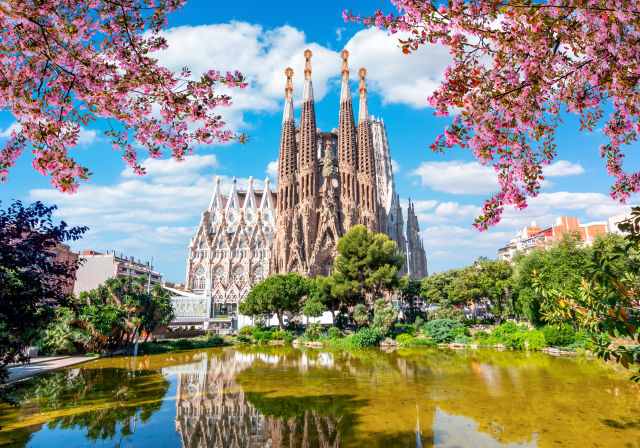
Barcelona has plenty of famous landmarks, but none has quite the same hold on the imagination as the Sagrada Família. For more than a century, Antoni Gaudí’s unfinished basilica has towered over the city in the most dramatic way possible. It’s part church, part architectural fever dream, part permanent construction site, and part reminder that some travel icons are worth waiting for. Now, after 144 years of work, the Sagrada Família has reached a massive milestone. The Tower of Jesus Christ is complete at 566 feet (172.5 meters), making the basilica the tallest church in the world.
The Sagrada Família is now the world's tallest church
The Tower of Jesus Christ reaches 172.5 meters (566 feet)
Construction began on March 19, 1882
The milestone comes 100 years after Antoni Gaudí's death
Pope Leo XIV inaugurated the tower on June 10, 2026
The basilica still has work remaining, including the Glory Façade
The Sagrada Família has never been a normal building project. Construction began in 1882, Gaudí took over the design in 1883, and the basilica has been evolving ever since through war, funding shortages, lost plans, changing technology, and generations of architects trying to stay faithful to his vision.
The newest milestone is the completion of the Tower of Jesus Christ, the tallest of the basilica’s 18 towers. Those towers are dedicated to the twelve apostles, the four evangelists, the Virgin Mary, and Jesus Christ. With the ceramic and glass cross now in place atop the central tower, the Sagrada Família rises to 566 feet (172.5 meters), surpassing Ulm Minster’s 530 feet (161.5 meters).
That makes this more than a Barcelona travel update. It’s one of those rare architectural moments where history, engineering, tourism, and city life all collide at once.
Part of what makes the Sagrada Família so famous is that it doesn’t look like anything else.
Gaudí designed the basilica as a Bible in stone, but he also pulled deeply from nature. The columns inside branch upward like trees, carrying the weight of the roof without the flying buttresses he considered architectural crutches. The ceiling feels almost like a forest canopy, and light pours through stained glass in warm oranges, reds, blues, and greens throughout the day.
From the outside, it’s even more surreal. The façades are covered in religious scenes, organic shapes, towers, sculptures, and tiny details that reward anyone who slows down long enough to actually look. It’s the kind of place where you can stand outside for 20 minutes and still feel like you’ve only noticed half of what’s in front of you.
The engineering behind the height is pretty remarkable, too. The upper towers, including the Tower of Jesus Christ, were built using pre-stressed stone panels reinforced with internal steel tendons. The technique helps keep the stone compressed when wind pushes against the tower, reducing the risk of cracking while preserving the window-heavy design Gaudí intended.
Gaudí spent the final 12 years of his life almost entirely devoted to the Sagrada Família. He eventually moved to the construction site and knew he would not live to see the basilica completed.
“My client is in no hurry,” he reportedly said, referring to God.
He died on June 10, 1926, after being struck by a tram while walking to the church. Because of his modest appearance, he was initially mistaken for a poor man and taken to a public hospital rather than private care. He died several days later at age 73.
A century later, Pope Leo XIV inaugurated the Tower of Jesus Christ on the exact centenary of Gaudí’s death, June 10, 2026, with a solemn Mass in Barcelona.
Important caveat for travelers: the Sagrada Família has reached its final height, but construction is not entirely over.
The Tower of Jesus Christ is complete, and that is what gives the basilica its new world record. But the Glory Façade, which will become the basilica’s main entrance, has not been built yet. Some estimates put full completion around 2035, though decorative and non-structural work may continue beyond that.
The Glory Façade is also the most contentious part of what remains. Plans for the new entrance have drawn pushback from nearby residents, who say the expansion could displace thousands of people in a city already under serious pressure from rising rents and overtourism. So yes, this is a huge architectural milestone, but the Sagrada Família story is not completely over.
I was in Barcelona in April, and even without going inside, I still wasn’t prepared for how overwhelming the Sagrada Família felt in person. It’s one thing to see photos of Gaudí’s basilica. It’s another thing entirely to stand beneath it, looking up at all those towers, carvings, and impossible details, and realize the photos don’t even come close.
For travelers, this new milestone gives Barcelona something genuinely exciting. The Sagrada Família was already one of the most visited monuments in Spain and Europe, but seeing it at its official final height is a different kind of experience.
This is one of those landmarks that can feel overhyped until you’re actually standing in front of it. Then it makes sense. It’s huge, strange, intricate, emotional, and almost impossible to fully capture in photos. The interior is where the building really becomes something else. Between the branching columns, the shifting colored light, and the sheer scale of the space, it’s one of the rare tourist attractions that still knows how to surprise people.
If there were ever a reason to put Barcelona back on your travel list, this might be it. Book tickets well in advance through the official website. Tower access sells out especially fast, and walk-up entry is not guaranteed. Give yourself more time than you think you’ll need.
Not entirely. The Tower of Jesus Christ, the tallest of the basilica’s 18 towers, was completed and inaugurated in June 2026, giving the church its world-record height of 172.5 meters.
However, the Glory Façade, which will become the basilica’s main entrance, has not yet been built. Full construction is estimated to continue until around 2035.
The Sagrada Família now stands at 172.5 meters, or 566 feet, making it the tallest church in the world.
Germany’s Ulm Minster held the title of world’s tallest church at 161.5 meters, or 530 feet, from 1890 until the Sagrada Família surpassed it.
Antoni Gaudí was a Catalan architect known for blending Catholic symbolism with organic, nature-inspired design. He took over the Sagrada Família project in 1883 at age 31 and devoted the final years of his life to it. He died in Barcelona in 1926 after being struck by a tram.
No. Despite its size, the Sagrada Família is a basilica, not a cathedral. A cathedral is the seat of a bishop. The tallest cathedral in the world is Cologne Cathedral in Germany.
Yes. The Sagrada Família is one of the most visited monuments in Europe, and timed-entry tickets can sell out quickly, especially if you want tower access. Book through the official website.
The project has relied on visitor admissions and private donations, which created recurring funding gaps. Construction was also disrupted by the Spanish Civil War in 1936, when much of Gaudí’s original documentation was destroyed. Later architects have had to work from surviving fragments, models, and interpretations of his vision.
The Glory Façade is the planned main entrance to the basilica, but some nearby residents say the expansion could displace thousands of people. The issue is especially sensitive because Barcelona is already dealing with rising rents, housing pressure, and overtourism.